
Your Ultimate Guide to Countertops

Countertops in kitchens, bathrooms, and laundry areas play a crucial role in our daily tasks at home. They must be both robust and aesthetically pleasing. Whether they seamlessly integrate into your spaces or bring a touch of character, choosing the right materials establishes the atmosphere of the room. Opting for countertops
that are both attractive and functional ensures an investment that provides daily benefits.
Choosing Your Stone
Selecting the appropriate material for a space can seem overwhelming, but considering a few essential factors can simplify the process. The location is crucial. Kitchens and bathrooms experience more daily use compared to laundry rooms. Regardless of the space, it's important to prioritize color, design, and budget. Here, we present an overview of some of our preferred materials.
Marble

Pro: durability
Con: more prone to staining compared to other natural stones
The color variations in marble, ranging from milky white to smoky blue-gray, are influenced by the minerals found in the area where it is extracted. A significant portion of Italian marble originates from the Carrara region, where clay and iron oxide add color to the natural calcite limestone. While marble is both beautiful and durable, it is prone to staining and needs regular sealing or polishing to rejuvenate a worn surface.
Quartzite

Pro: longevity
Con: restricted color options
Quartzite is one of the most long-lasting materials available on the market. It resembles marble but is harder and less porous. Originating from quartz sandstone that has been compressed by heat and pressure, quartzite is a natural stone that needs regular sealing. Its durability makes it suitable for any room, but this robustness results in higher expenses for cutting, shaping, and installation.
Soapstone

Pro: simple everyday upkeep
Con: prone to chips and dents
Made up of magnesium-rich talc and other minerals, soapstone is heat-resistant, nonporous, naturally stain-resistant, and does not require a sealant. It is also naturally antimicrobial, which is an advantage in kitchens and bathrooms. As time passes, the charcoal gray stone oxidizes, giving it a rich patina. Being softer than other natural stones, soapstone is more prone to dents, chips, and scratches, but it is also simpler to shape and install.
Quartz

Pro: requires little upkeep
Con: sensitive to heat
In contrast to quartzite, quartz countertops are made from a combination of resin, minerals, and pigments. Being a manufactured product, quartz does not need sealing and can be designed to mimic any material, like granite or marble. The finishes are comparable to those of natural stone, and it can be polished, honed, or leathered. Quartz is simple to maintain, although exposure to high heat may result in burn marks.
Granite
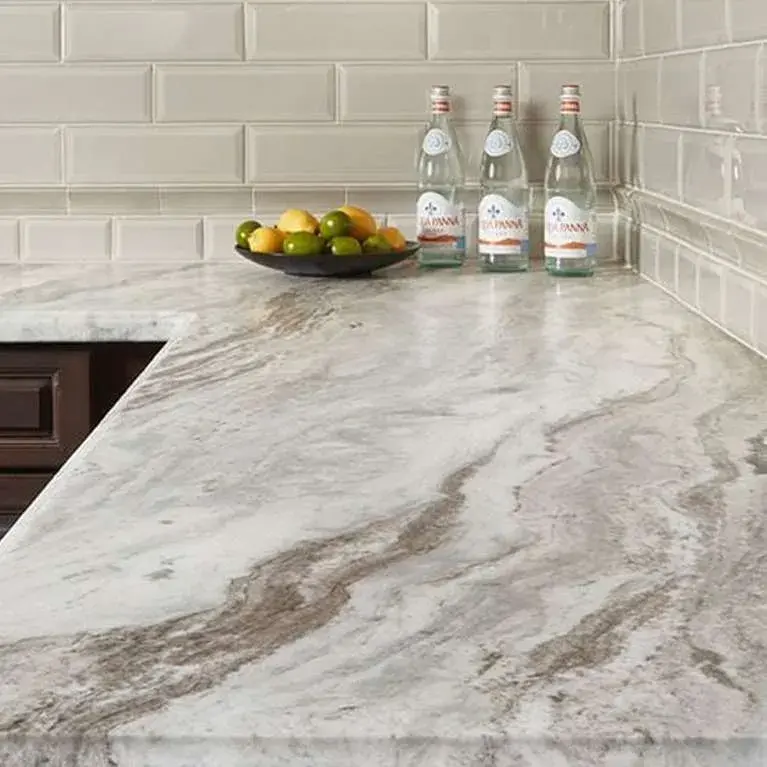
Pro: scratch-resistant
Con: needs frequent sealant application
This natural stone is renowned for its durability and can effortlessly endure the daily wear and tear. To maintain granite's stain resistance, applying a sealant is necessary. Certain granite slabs exhibit more natural patterns or "movement" than others, so ensuring that the style of a specific slab suits your space may require additional time and effort.
Thickness and Finnish
The thicker the material, the more expensive it becomes. To achieve a luxurious appearance without overspending, think about attaching 1-centimeter laminated edges to the sides of a 2-centimeter countertop.
Standard counters are usually polished, though you have the option to choose a matte finish. Be prepared for extra expenses if you select more intricate processes such as leathering.

Polished Stone features a shiny, reflective surface that is simple to clean and maintain.
Honed Stone is polished to achieve a smooth, matte texture that is more understated and conceals imperfections.
Leathered Stone undergoes sanding, washing, and brushing to achieve a natural appearance that resists scratches.
Edges
When choosing an edge, think about the thickness of your counters. A rounded bullnose might look timeless on a 2- or 3-centimeter counter but chunky on anything larger. For a modern look, try a straight or eased edge. In a more traditional space, an ogee detail can add elegance. Use this list to understand the most common options.



Comments